Getting Chikungunya in Nicaragua: Our Experience and What Travelers Should Know

A sudden, intense fever in Nicaragua was followed by rash and joint pain so severe that walking became agony. Our illness was never medically confirmed, but it closely matched chikungunya during a documented outbreak. This is what happened to us and what we wish we had known.
A note about our diagnosis: Neither of us received a laboratory test. Based on the hallmark fever, rash and severe joint pain, together with the documented Nicaragua outbreak, we are confident that we had chikungunya and use that wording throughout this article. Other mosquito-borne illnesses can produce overlapping symptoms, so our experience is not a substitute for medical testing or professional diagnosis.
One day in Nicaragua, I felt the first hint of a fever. It did not stay mild for long.
The fever rose quickly and became one of the most intense I have ever experienced. For roughly 36 to 48 hours, I felt as though I was burning from head to toe. At the same time, the pain in my joints became almost impossible to ignore. Walking was agony.
After the fever eased, a severe rash took its place for approximately another 48 hours. The rash eventually faded, but the joint pain did not. Instead of improving steadily, it became worse over the following three weeks.
My wife became sick later. Her illness started with a similarly terrible fever that lasted about 36 hours, but her joint pain was not as severe. She did not take an anti-inflammatory medication and felt largely recovered after about a week.
We were fortunate that we did not become sick at exactly the same time. Looking after our children while acutely ill was essentially impossible. Having even a small gap between our illnesses made an enormous difference.
About three weeks after my fever began, I finally obtained a nonsteroidal anti-inflammatory drug, or NSAID, from a pharmacy. After five days, I could walk and move around much more comfortably, although some joint pain remained. In hindsight, I should have sought qualified medical care earlier instead of assuming the pain would simply disappear.
Why we are confident it was chikungunya
Chikungunya is a viral illness transmitted through the bites of infected Aedes mosquitoes. Its defining symptoms are a sudden fever and joint pain, which can be severe and disabling. Rash, fatigue, headache, muscle pain, nausea and joint swelling can also occur. Symptoms usually begin several days after an infected mosquito bite.
That pattern closely resembled what we experienced: abrupt fever, intense joint pain, difficulty walking and a rash that followed the fever. My wife’s faster recovery and milder joint pain also fit the wide range of experiences reported with the illness.
The timing matters too. The CDC’s current Nicaragua chikungunya notice, reviewed on September 3, 2026, states that there is an outbreak in Nicaragua and advises travelers to practise enhanced precautions. The U.S. Embassy in Managua issued a health alert on August 4, 2026, describing the risk as present throughout the country. Our illness began around August 2026, during that same period.
Our symptoms, timing and the documented outbreak give us confidence that the illness was chikungunya. The Government of Canada explains that chikungunya diagnosis can involve symptoms, laboratory results, season and travel location. We did not receive laboratory confirmation, and we want readers to understand that limitation.
Our symptom timeline
| Stage | My experience | My wife’s experience |
|---|---|---|
| Onset | A feverish feeling escalated rapidly into an extreme fever | Symptoms began later, giving us some ability to cover for each other |
| First 36 to 48 hours | Intense fever, severe joint pain and walking that felt agonizing | Roughly 36 hours of terrible fever, with less severe joint pain |
| After the fever | Approximately 48 hours of a dramatic rash | No major rash experience was recorded in our notes |
| Following weeks | Joint pain continued and worsened over about three weeks | Felt largely recovered after approximately one week |
| After seeking relief | After five days using an NSAID obtained from a pharmacy, mobility improved, but some joint pain remained | Did not use an NSAID |
This is only our timeline. The CDC overview of chikungunya symptoms says most patients feel better within a week, but severe joint pain can persist for months. The CDC Yellow Book chikungunya chapter also notes that some patients experience continuing or recurring rheumatologic symptoms and prolonged fatigue.
What chikungunya can feel like
Official descriptions often list fever, joint pain and rash in a few lines. Those terms do not fully communicate what the illness can feel like.
For me, the fever was not simply uncomfortable. It was overwhelming. The joint pain made an ordinary movement such as walking feel punishing. Once the fever and rash had passed, I expected the joint pain to follow. Instead, it became the longest and most disruptive part of the illness.
My wife’s experience was different. Her fever was also severe, but the joint symptoms were milder and her recovery was much faster. That contrast is useful for travelers to understand. Two people exposed in the same country, during the same trip, can have very different recoveries.
The World Health Organization’s chikungunya fact sheet describes the joint pain as often debilitating and says it may last for weeks, months or even years. Most people recover fully, but there is no reliable way for a traveler to predict whether their joint symptoms will resolve quickly.
The medication lesson we learned too late
The most important medical lesson from our experience is not that travelers should buy the same medication I used. It is that severe fever and joint pain after travel deserve professional assessment.
I waited about three weeks before obtaining an NSAID from a pharmacy because I believed I would improve on my own. The medication was followed by a major improvement in my mobility, but that does not establish a diagnosis or mean the same medication is appropriate for every traveler.
Chikungunya and dengue can cause overlapping symptoms, and both occur in Nicaragua. The CDC’s chikungunya treatment guidance says suspected chikungunya should be managed as dengue until dengue has been ruled out. The CDC and the World Health Organization recommend acetaminophen, also called paracetamol, as the preferred first-line option for fever and pain until dengue is excluded. Aspirin and other NSAIDs can increase bleeding risk in a person with dengue.
That distinction is why this article does not recommend a specific medicine, dose or schedule. Medication decisions are especially important for children, pregnant travelers, older adults, people with chronic conditions and anyone taking other medicines. Speak with a qualified clinician or pharmacist who understands your medical history and the infections circulating in the area.
When to seek medical care
The Public Health Agency of Canada advises travelers to consult a healthcare provider if they become ill after visiting an area where chikungunya is present and to explain their symptoms and travel history.
Do not wait for a blog post or online symptom list to settle the diagnosis. Seek prompt medical advice for fever, significant joint pain, rash or other concerning symptoms during or after travel. Tell the clinician where and when you traveled.
Dengue deserves particular attention because warning signs can appear after the fever begins to ease. The CDC’s dengue warning-sign guidance says to seek emergency care for symptoms such as severe abdominal pain, repeated vomiting, bleeding from the nose or gums, blood in vomit or stool, or extreme tiredness and restlessness.
Persistent or worsening joint pain also deserves follow-up. The illness may be over while the musculoskeletal symptoms continue, and a clinician can consider chikungunya alongside other infectious and rheumatologic causes.
What happens if both adults in a family become sick?
This was the part of the experience we were least prepared for.
When the fever and joint pain were at their worst, looking after the children was not merely difficult. It was impossible. We were lucky that our illnesses were staggered rather than simultaneous, but relying on luck is not a family travel plan.
For future trips, we would think through a simple illness backup plan before arrival:
- Keep contact details for the accommodation host, a trusted driver and a nearby clinic.
- Make sure both adults can access travel insurance information, passports, emergency contacts and payment methods.
- Keep water, oral rehydration supplies, simple food and age-appropriate family medications available.
- Give a trusted person at home the itinerary and accommodation details.
- Know who could help with the children if both adults became unable to function.
- Avoid an itinerary so tightly scheduled that one illness creates a chain of missed transfers and non-refundable bookings.
The Government of Canada’s Nicaragua travel advice notes that good medical care is limited outside Managua, private care can be expensive and medical evacuation may be necessary for serious illness. It recommends travel insurance that covers hospital stays and evacuation. That advice feels much more concrete after experiencing an illness that suddenly made ordinary movement difficult.
How travelers can reduce the risk
The mosquitoes that transmit chikungunya, particularly Aedes aegypti and Aedes albopictus, commonly bite during daylight hours. Protection cannot be limited to bedtime.
The Government of Canada insect-bite guidance, CDC traveler mosquito guidance and WHO chikungunya fact sheet support using several protections together rather than relying on one product.
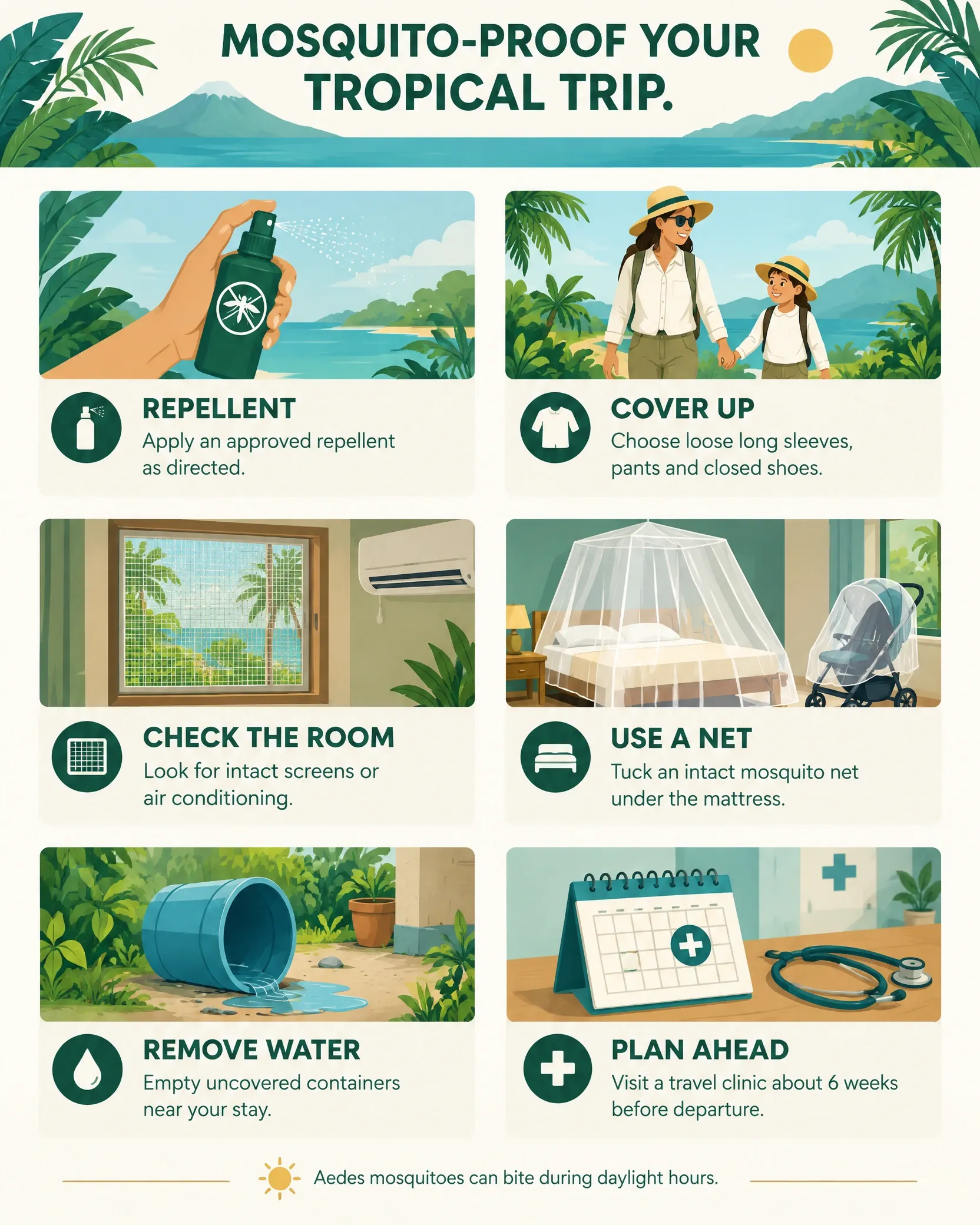
Original family travel infographic created for Our Life Adventures using current Canadian, CDC and WHO prevention guidance.
Before departure
Visit a healthcare provider or travel clinic before the trip. The Government of Canada recommends doing this preferably six weeks before departure so there is time to discuss destination-specific risks, vaccination and personal health considerations.
Pack a dedicated mosquito-protection kit rather than assuming every product will be available locally:
| Pack | How it helps |
|---|---|
| Approved insect repellent | Apply it to exposed skin exactly as directed on the label, including the stated reapplication interval and age restrictions. |
| Loose, tightly woven clothing | Long sleeves, long pants, socks and closed shoes reduce exposed skin. Mosquitoes may bite through very thin fabric. |
| Permethrin-treated clothing and gear | Pre-treated clothing, socks, footwear and outdoor gear add protection. Follow the product directions and do not apply permethrin products intended for fabric directly to skin. |
| Travel mosquito net | Bring one when staying in open-air, unscreened or uncertain accommodations. Check that it is intact before relying on it. |
| Netting for young children | A fitted net can protect a stroller, playpen or sleep space when the area cannot be fully enclosed. |
| Basic screen-repair supplies | A small roll of removable repair tape can temporarily close a torn screen while the host arranges a proper repair. |
Use repellent correctly
Apply sunscreen first and insect repellent afterward. Do not spray repellent directly onto the face, cuts or irritated skin. Wash your hands after applying it and keep it away from the eyes and lips. For children, confirm that the exact product is approved for their age and follow its label rather than assuming an adult product or application schedule is suitable.
Reapply only as directed. Swimming, heavy sweating, rain and long outdoor days may affect protection, but more product is not automatically better. Carry the repellent during outings instead of leaving it in the room.
Do a two-minute room check
Before unpacking, inspect the room while there is still time to request a repair or change rooms:
- Check window, door and vent screens for holes or loose edges.
- Confirm exterior doors close fully and are not routinely left open.
- Look under beds, around bathrooms and near balconies for mosquitoes already inside.
- Check outdoor areas for uncovered buckets, plant saucers, toys or other containers holding water.
- Test the air conditioning or fan and ask the host to repair damaged screens promptly.
When screening is incomplete, sleep under an intact mosquito net tucked securely under the mattress. Keep skin away from the net because mosquitoes can bite through material resting directly against the body. Use properly fitted netting over strollers and playpens for infants and young children.
Protect the whole day, not only dusk
The Aedes mosquitoes responsible for chikungunya often bite during daylight hours, including indoors. Use protection during breakfast on a patio, school or market visits, pool time, hikes and afternoon rests, not only during evening meals.
Light-coloured, loose clothing can make tropical heat easier to manage while covering more skin. Keep repellent near the door so applying it becomes part of leaving the room, just like taking keys and water.
Reduce standing water around longer stays
Mosquitoes can breed in surprisingly small amounts of water. At a vacation rental or longer-term stay, empty or cover buckets, plant saucers, children’s toys and other open containers that collect rain. Ask the property manager to address larger water-storage or drainage problems rather than treating them yourself.
If someone becomes sick
A person with chikungunya can have virus circulating in the blood during the early illness. The CDC chikungunya treatment and prevention guidance advises people with suspected or confirmed infection to prevent additional mosquito bites during the first week of illness. Rest in a screened or air-conditioned room, use a mosquito net when needed and continue appropriate repellent and clothing precautions. This helps reduce the chance that a mosquito acquires the virus and carries it to another person.
What Canadian travelers should know about vaccination
Vaccination guidance is changing as products and outbreak conditions evolve. The Government of Canada says a chikungunya vaccine is approved in Canada and recommends consulting a healthcare provider or travel clinic, preferably six weeks before departure, for personalized advice.
For the current Nicaragua outbreak, the CDC Nicaragua traveler page recommends chikungunya vaccination for people traveling to an outbreak area. Canadian travelers should ask a qualified Canadian travel-health professional whether vaccination is available and appropriate for their age, itinerary, trip length and health history.
Do not assume that a vaccine recommendation applies identically to every traveler. Product authorization, age indications, availability and individual contraindications can change.
What we would do differently
1. Seek medical care earlier
Waiting three weeks while the joint pain worsened was not a good plan. Even if the eventual treatment remained supportive, earlier evaluation could have considered dengue and other causes, provided safer medication guidance and established a recovery plan.
2. Treat the fever and joint pain as more than a routine travel bug
A sudden high fever paired with severe joint pain is a pattern worth taking seriously. The intensity and loss of mobility separated this illness from the short stomach bugs and ordinary colds travelers often try to manage themselves.
3. Build a family backup plan
We were fortunate not to be incapacitated at exactly the same time. On future trips, we would identify local help and a clinic before anyone became sick.
4. Protect against daytime mosquito bites
We would be more consistent with repellent and protective clothing throughout the day, not only at night or during obvious outdoor excursions.
5. Plan for recovery after the fever
The end of the fever did not mean the end of the illness. Travelers should leave room for recovery and avoid assuming they will immediately resume hikes, transfers or long driving days.
Frequently asked questions
Was our chikungunya laboratory-confirmed?
No. We describe the illness as chikungunya because the symptoms were strongly characteristic and occurred during a documented Nicaragua outbreak. Neither of us received a laboratory test, and other illnesses, especially dengue, can overlap with this symptom pattern.
How long did the fever last?
My fever felt extreme for roughly 36 to 48 hours. My wife’s severe fever lasted about 36 hours. These are personal recollections rather than timed clinical measurements.
How long did the joint pain last?
My joint pain worsened for approximately three weeks. After five days using an NSAID obtained from a pharmacy, I could walk and move more comfortably, although some joint pain remained. My wife’s joint symptoms were milder and she felt largely recovered after about a week.
Should travelers take an NSAID for suspected chikungunya?
Do not use our experience as medication advice. Public-health guidance recommends treating suspected chikungunya as possible dengue until dengue has been ruled out. Because NSAIDs and aspirin can increase bleeding risk in dengue, seek professional advice before using them for an undiagnosed travel-related fever.
Is there currently a chikungunya outbreak in Nicaragua?
Yes. As of September 2026, the CDC lists a chikungunya outbreak in Nicaragua and recommends enhanced precautions, mosquito-bite prevention and medical care for compatible symptoms.
Can chikungunya joint pain continue after the fever?
Yes. Most people improve within about a week, but official public-health guidance recognizes that joint pain can remain severe and can last for weeks or months. Some people experience longer-lasting symptoms.
Final thoughts
We love Nicaragua, and this experience does not change that. It does change how we will prepare for future trips.
Mosquito-bite prevention can feel like a background item on a packing list until a mosquito-borne illness stops a trip in its tracks. The fever was intense, the joint pain was disabling and the recovery was much longer for me than for my wife. Looking after our children became impossible during the worst stage, and we were fortunate our illnesses did not fully overlap.
The biggest lesson is simple: take the risk seriously without panicking. Use consistent bite protection, check current travel-health notices, speak with a travel-health professional before departure and seek medical care when severe symptoms begin. If fever and joint pain develop together, do not assume you know the diagnosis and do not wait weeks for worsening pain to resolve on its own.
Medical disclaimer: This article shares our personal experience with chikungunya, which was not laboratory-confirmed, and summarizes public-health information available in September 2026. It is not medical advice and cannot diagnose chikungunya, dengue or any other condition. Seek advice from a qualified healthcare professional for symptoms, testing, medication decisions and travel vaccination.
Sources and further reading
| Authority | Guidance |
|---|---|
| Government of Canada | Chikungunya prevention and vaccine guidance |
| Government of Canada | Insect-bite prevention for travelers and families |
| Government of Canada | Chikungunya symptoms and when to consult a healthcare provider |
| Government of Canada | Chikungunya diagnosis and treatment overview |
| Government of Canada | Nicaragua travel advice and medical-care limitations |
| CDC Travelers’ Health | Chikungunya outbreak notice for Nicaragua |
| CDC Travelers’ Health | Nicaragua traveler health information |
| CDC | Chikungunya symptoms |
| CDC | Chikungunya treatment and prevention |
| CDC | Preventing mosquito bites while traveling |
| CDC Yellow Book | Clinical and traveler guidance for chikungunya |
| CDC | Dengue warning signs and testing |
| World Health Organization | Chikungunya fact sheet |
| Pan American Health Organization | Chikungunya overview for the Americas |
| U.S. Embassy in Nicaragua | August 2026 Nicaragua chikungunya health alert |